

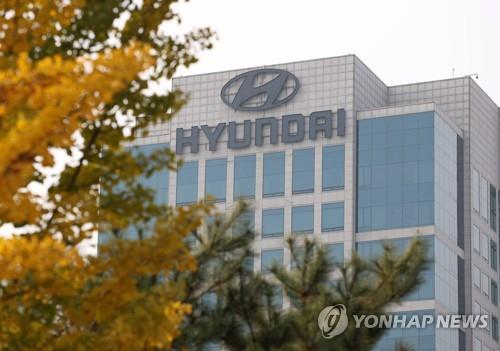
SEOUL, Oct. 26 (Yonhap) — Hyundai Motor Co., South Korea’s largest carmaker, reported Thursday that its third-quarter net income had increased by over 130 percent year-on-year, due to a strong growth in global sales.
Consolidated net profit amounted to 3.3 trillion won (US$2.4 billion), a rise of 134 percent compared to the same period the previous year, as stated in a regulatory filing.
Sales rose 8.7 percent to 41 trillion won and operating profit increased 146.3 percent to 3.82 trillion won, surpassing the market’s expectations.
The survey conducted by Yonhap Infomax, the financial data firm of Yonhap News Agency, had the average prediction of net profit to be 2.87 trillion won.
Hyundai Motor sold 1,045,510 vehicles in the third quarter, a 2 percent increase from the same period in the prior year. The company also saw a 33.3 percent growth in global sales of eco-friendly vehicles, including new models of its Ioniq brand.
The rate of hybrid units among Hyundai’s total cars sold in the period rose to 8.6 percent from 5.7 percent last year, and those for EVs climbed to 6.3 percent from 5.1 percent.
Sales of the company’s luxury brand Genesis also grew, accounting for 5.1 percent of all Hyundai models sold in the period, up from 4.9 percent in the year before.
SUV models made up 54.7 percent of all cars sold by the company, excluding Genesis models, an increase from 50.6 percent the year before. When Genesis SUV units were included, the rate rose to 57.8 percent.
Hyundai noted potential challenges, such as tensions in the Middle East, persistent inflationary pressures and a possible reduction in demand in emerging economies due to high interest rates.
The company plans to focus on enhancing the global recognition of its Ioniq brand and further expanding sales of its eco-friendly vehicles by reinforcing its hybrid lineup.
It also intends to improve the product mix of its premium models by introducing updated Genesis GV80 models and a GV80 coupe.
Despite slowing sales of EVs, Hyundai Motor Group aims to start production at its 300,000-unit-a-year EV and battery plant in Georgia in the second half of 2024 to take advantage of tax credits for locally produced EVs, according to Seo Gang-hyun, executive vice president in charge of Hyundai’s finance and accounting division.
In response to the Inflation Reduction Act which gives up to $7,500 in tax credits to buyers of EVs assembled only in North America, Hyundai Motor began to produce the all-electric GV70 SUVs at its Alabama plant early this year.
Shares in Hyundai Motor fell 1.37 percent to 179,500 won on the Seoul bourse Thursday, in line with the broader Korea Composite Stock Price Index’s 2.71 percent loss.