

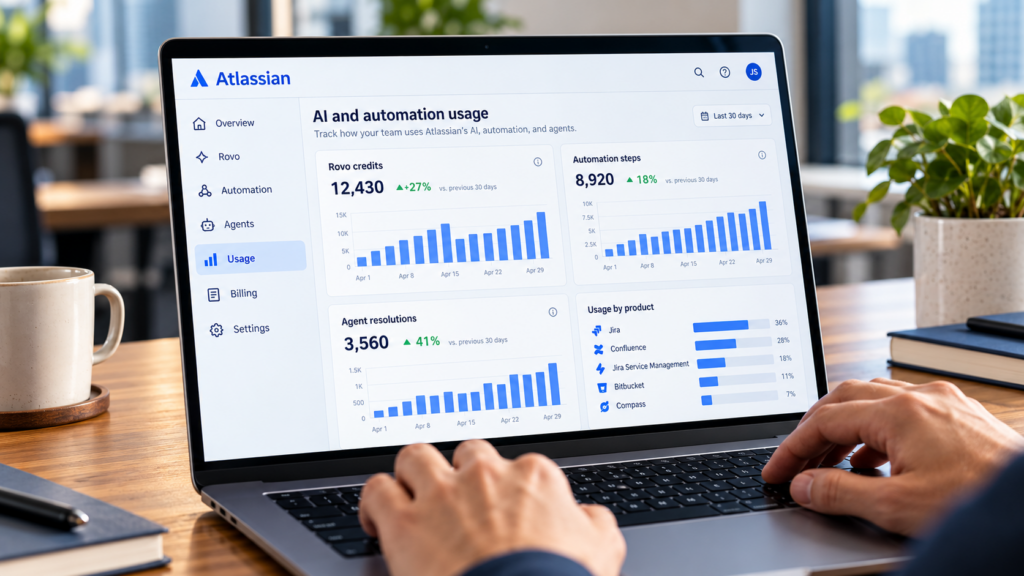
Atlassian said on September 1 that it will expand usage-based pricing across AI and automation features. Most paid cloud plans will retain bundled allowances, but from December 3 customers can face additional charges for Rovo credits, automation steps and service requests resolved autonomously by an AI agent. Successful AI-agent resolutions will cost $1 each from the first resolution.
The significance lies in Atlassian’s rationale: as software moves from assisting individual users to orchestrating workflows, seat count no longer captures the value being delivered. That is a direct challenge to one of the most durable economic models in enterprise technology.
Why Per-Seat Pricing Is Under Pressure
Per-seat pricing worked because employees were both the users and the rough unit of demand. A larger workforce usually meant more accounts, more activity and more subscription revenue. An AI agent can perform dozens of tasks without a separate human login. A single employee may supervise automated workflows that once required several users to operate software manually.
This creates a tension for vendors. AI products are sold on the promise of raising productivity and reducing routine labor, while the traditional commercial model earns more when the customer’s headcount rises. If automation allows a company to do the same work with fewer users, the vendor can deliver more value while selling fewer seats. Charging for actions or outcomes gives the supplier a way to participate in the economic value of the work performed by software.
Atlassian’s approach is additive rather than a wholesale abandonment of subscriptions. Existing plans provide allowances, while organizations can upgrade, prepay or pay as they go for additional capacity. Different activities have different meters: AI interactions, automation steps and completed service resolutions. This hybrid structure is likely to be the practical path for large vendors. A base subscription preserves some revenue visibility, while a variable layer monetizes agent activity.
Salesforce already offers several pricing units for Agentforce. Customers can buy 100,000 Flex Credits for $500, with a standard agent action consuming 20 credits, equivalent to $0.10. A separate conversation model is priced at $2 per conversation, while user-based licenses remain available for some deployments. Intercom moves closer to outcome pricing: its Fin agent generally charges $0.99 for a successful resolution and $9.99 for a qualified lead.
Usage Pricing Shifts Risk to the Buyer
These choices allocate risk differently. Consumption pricing places volume risk on the buyer because the bill rises with requests, actions or compute use. Outcome pricing ties revenue more closely to a useful result, but it requires an auditable definition of success. If an AI agent closes a case and the customer returns with the same problem, supplier and buyer may disagree over whether a billable outcome occurred.
Variable pricing also complicates technology budgets. Seat counts can be forecast before the year begins; agent activity depends on adoption, workflow design and the complexity of individual tasks. Vendors therefore need metering dashboards, alerts and controls alongside the AI product itself. Atlassian says administrators will be able to monitor current use, forecast demand and set limits.
For software companies, the change affects revenue quality as well as pricing. Annual recurring revenue based on seats gives investors a relatively simple measure of future sales. Usage-based revenue can accelerate when adoption expands, but it is more sensitive to customer activity and optimization. Buyers may redesign workflows to reduce unnecessary actions just as they have learned to manage cloud-computing costs.
Enterprise Contracts Will Become Hybrid
Deloitte expects a gradual transition rather than the disappearance of subscriptions. Citing Gartner, it says at least 40% of enterprise SaaS spending could shift toward usage-, agent- or outcome-based pricing by 2030. That is a forecast, not a current market share. Large customers still value predictable budgets, access rights, support and service guarantees.
The probable end state is a contract containing several economic units. A seat may pay for access, credits may cover AI consumption, and selected workflows may be priced by verified outcomes. Procurement teams will then need to compare total cost under different usage scenarios rather than treating the license price as the complete bill.