

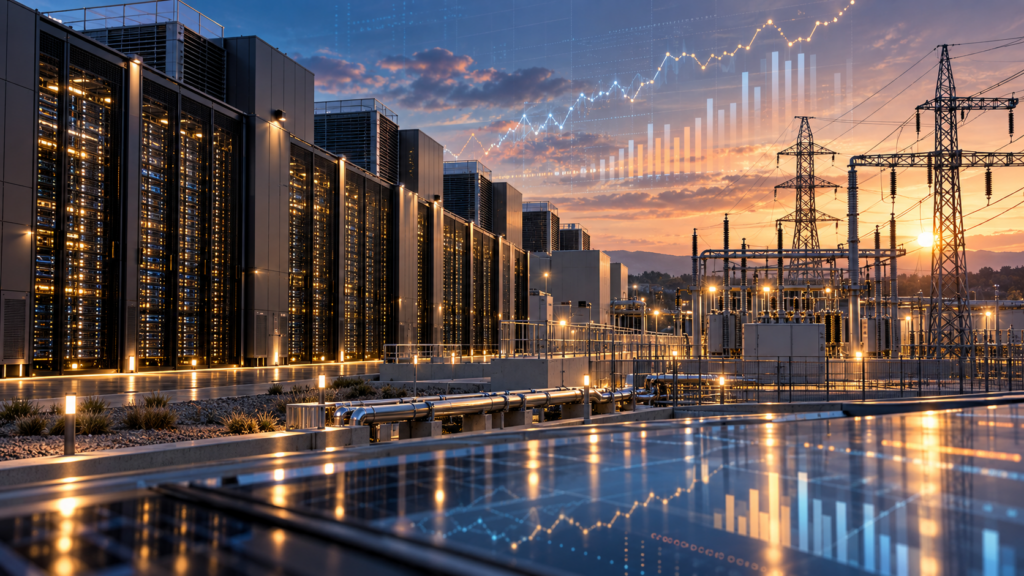
Technology companies accounted for roughly 27% of US investment-grade corporate issuance and 60% of convertible issuance through 11 September 2026, according to S&P Global Market Intelligence. S&P described the sector’s 2026 capital-raising activity as record-level. The figures capture more than a burst of opportunistic financing: they show how the economics of artificial intelligence are changing the capital structure of an industry once defined by excess cash.
The largest cloud groups remain highly rated and continue to generate substantial operating cash flow. Their recourse to debt is not, by itself, a sign of financial weakness. The change is the size and timing of the investment programme. AI capacity requires companies to secure accelerators, networks, buildings, cooling systems and electricity at the same time. The useful lives of those assets differ sharply. Chips may become economically obsolete well before data-center shells, substations and transmission connections do.
Matching that mix of assets with retained cash alone would reduce financial flexibility. Bonds, leases, preferred shares and project-level structures allow companies to spread payments, preserve liquidity and continue shareholder distributions. They also introduce fixed claims that must be serviced whether a new facility is full or half empty.
Capex Is Moving Closer to Operating Cash Flow
Company filings show the scale of the transition. Alphabet reported $80.6 billion of capital expenditure and $84.9 billion of operating cash flow in the first half of 2026. In the second quarter alone, capital expenditure of $44.9 billion exceeded operating cash flow of $39.1 billion. During the first half, Alphabet issued $51.8 billion of senior notes. In June it also raised $49.6 billion net through common shares and mandatory convertible preferred stock, with proceeds available for purposes including AI infrastructure and global compute.
Amazon reported $96.3 billion of cash capital expenditure in the first six months of 2026, primarily for technology infrastructure and fulfilment capacity. Proceeds from short- and long-term debt and other borrowings were $82.4 billion. Its trailing-12-month free cash flow moved to a $7.6 billion outflow, which the company attributed mainly to a $66.1 billion year-on-year increase in property and equipment purchases, largely for AI.
Meta expects capital expenditure of $130 billion to $145 billion in 2026 to support AI and its core business. It received $24.91 billion net from a senior-note issue in May and ended June with $83.66 billion of long-term debt. Microsoft, by contrast, remained strongly cash generative in its June quarter: operating cash flow was $55.4 billion and free cash flow was $19.6 billion. Yet capital expenditure including finance leases reached $41 billion, and its revised calendar-2026 expectation was about $175 billion. Roughly two-thirds of quarterly capex went to shorter-lived assets, primarily CPUs and GPUs.
Bond Markets Are Starting to Differentiate Issuers
These cases matter because the bond market is beginning to price the build-out as a continuing programme rather than a temporary surge. Reuters, citing Goldman Sachs data, reported that gross hyperscaler debt issuance could reach a record $420 billion in 2027, 60% above the 2026 estimate. That figure is a forecast, not committed spending, and gross issuance can include refinancing. It nevertheless indicates the amount of capacity investors may be asked to absorb.
The first effect is visible in spreads. Reuters reported spreads of about 115 basis points for AI-related issuers, compared with 78 basis points for the broader investment-grade market. S&P Global Market Intelligence said technology investment-grade spreads had widened by about 50 basis points relative to the wider market since late 2025, partly reflecting heavier supply.
This is not primarily a default story. Portfolio managers have to manage the volume, timing and concentration of issuance. A single economic exposure can appear through a parent company’s bonds, a guaranteed data-center vehicle and other associated financing structures. Even an investor comfortable with the credit may reach an internal single-name limit.
The spillover to other borrowers is more nuanced than a simple crowding-out narrative. SIFMA recorded $1.8998 trillion of US corporate bond issuance through August, up 29.8% from a year earlier. Heavy supply can require larger concessions from frequent technology issuers. At the same time, Reuters reported strong demand for less common pharmaceutical and insurance paper as investors looked beyond hyperscalers. For now, AI financing is segmenting the credit market: it is raising the supply premium for some technology borrowers while improving scarcity value elsewhere.
The Real Test Is Return on New Capacity
The more difficult test is the return on the assets. Total company revenue is a poor measure because the same data center can serve conventional cloud workloads, internal AI products and external model developers. The relevant measure is incremental cash generation after electricity, maintenance, staffing, equipment replacement and interest.
A simple illustration shows why borrowing costs matter. Every $100 billion of debt carries $5 billion of annual interest at 5%, or $6 billion at 6%, before principal repayment or operating expenses. The revenue required to support that debt depends on utilization, pricing and margins. If accelerators have to be replaced sooner than expected, or if capacity comes online ahead of customer demand, the hurdle rises quickly.
Long-term customer commitments can reduce that uncertainty, and operators can improve economics by allocating capacity across internal and external workloads. Neither remedy eliminates risk. Power prices can erode contract margins, while rapid semiconductor advances can shorten the commercial life of installed equipment.
Debt markets are therefore becoming a practical discipline on the AI investment cycle. The largest companies still have ample access to capital. But each new issue gives investors another opportunity to demand a concession, assess whether contracted demand is credible and compare prospective returns with the cost of funding. The pace of AI infrastructure investment will increasingly depend not only on technological ambition, but on demonstrated utilization and cash flow.