

More than 80% of trade invoices in ASEAN+3 are still denominated in US dollars, according to an analysis published by the IMF in September. The dollar also accounts for about 85% of foreign-exchange settlement in the region and more than half of banks’ cross-border assets and liabilities.
Those figures do not point to a rapid retreat from the dollar. What is changing is narrower and more practical: Asian countries are building payment links that let some transactions move directly between local currencies instead of routing through the dollar.
That distinction matters. A retail payment, remittance or supplier invoice can avoid an intermediate conversion without changing the currency used for corporate funding, reserves or emergency liquidity.
Regional trade makes direct settlement more useful
The economics have improved as more Asian trade stays within the region. Two decades ago, nearly one-third of the value added exported by ASEAN+3 ultimately went to the United States. The share is now about one-fifth, while China and ASEAN each account for roughly 10% of regional demand, up from about 6% apiece.
A payment between two Asian companies can still involve two currency conversions: the buyer’s currency into dollars, then dollars into the supplier’s currency. Each step adds a spread, requires liquidity and may involve another correspondent bank.
Direct settlement removes the intermediate currency, but it does not remove foreign-exchange risk. Banks still need to quote the currency pair, and companies still need a way to hedge the exposure. That is why local-currency settlement works best on corridors with enough two-way trade to create demand for both currencies.
Malaysia shows how far that can go. Bank Negara Malaysia says local currencies accounted for 18.7% of bilateral trade settlement with Thailand in 2024, up from 6.4% in 2009. The shares reached 11.9% with Indonesia and 28.4% with China.
Cross-border QR payments are creating scale
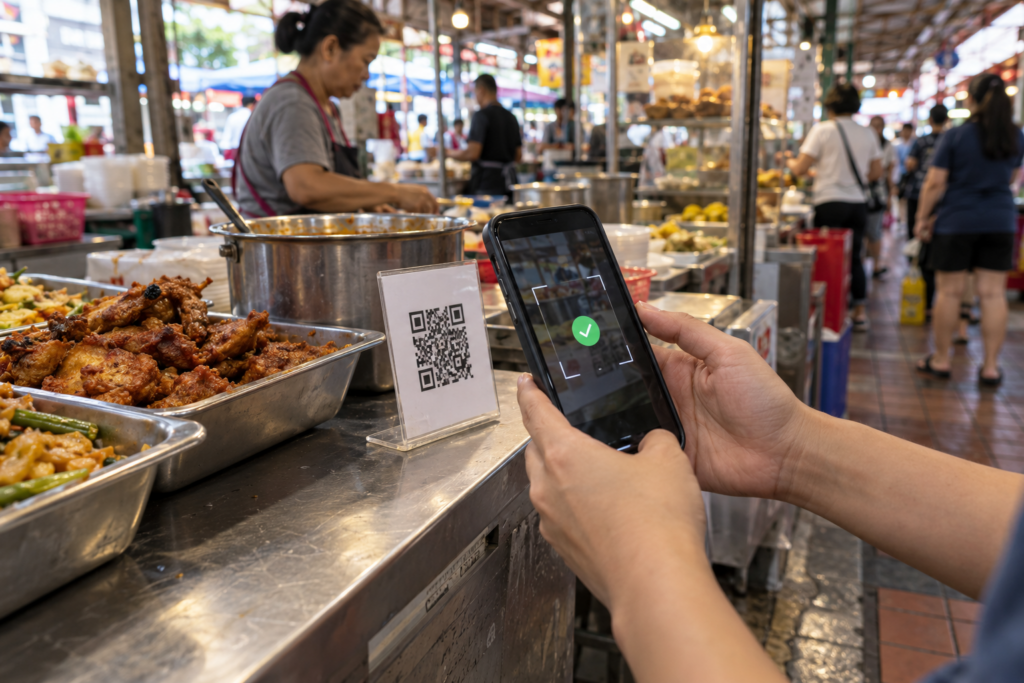
The fastest expansion is visible in retail payments. ASEAN had 29 live cross-border links between national instant-payment systems by the end of 2025. In 2026, Bank Negara Malaysia said more than 50 million merchant touchpoints across the region could accept cross-border QR payments.
For the customer, the experience remains familiar: open a domestic banking app, scan the merchant’s code, review the exchange rate and confirm the payment. Behind the transaction, the networks still have to exchange standardised messages, convert currencies, identify participating institutions and settle positions between financial firms.
For small merchants, this can matter more than the reserve-currency debate. Card acceptance can require dedicated equipment and merchant fees. A national QR standard can work with an existing bank account and extend that domestic payment network to foreign visitors.
Malaysia had almost three million DuitNow QR touchpoints by the end of 2025, with small businesses making up a large share. Its central bank links wider QR adoption to lower acceptance costs, faster access to funds and a digital transaction history that can support access to other financial products.
Nexus is designed to reduce the cost of adding another market
Bilateral connections become harder to manage as the number of participating countries grows. If every national instant-payment system needs a custom link to every other system, technical and governance costs increase with each new participant.
Project Nexus is designed around a different model. A domestic instant-payment system connects once to a common platform and can then reach other participating systems through the same scheme.
In 2025, the central banks of India, Indonesia, Malaysia, the Philippines, Singapore and Thailand incorporated Nexus Global Payments to move the project toward implementation.
The potential benefit is not simply faster settlement. Standardised participation can reduce the cost for banks and payment companies to enter additional markets and can make fees and foreign-exchange pricing easier for customers to understand.
The difficult part is regulatory rather than technical. Countries still need compatible rules for customer checks, anti-money-laundering controls, refunds, fraud liability and access to foreign-exchange liquidity. Faster payments also leave less time to stop a fraudulent transfer.
The dollar still solves a different problem
Retail connectivity and reserve currencies operate at different levels. A tourist payment can settle directly between two local currencies, while a large corporate treasury may still prefer to borrow, invest and hedge in dollars.
Most Asian currencies do not offer markets for safe assets and derivatives on the same scale as the dollar. Banks need collateral that can be sold or financed quickly under stress. Companies need deep hedging markets across maturities. Central banks need assets that remain liquid when private markets come under pressure.
Network effects reinforce that role. Existing contracts, loans, reserves and commodity prices are already concentrated in dollars. Using the same currency remains efficient until a regional corridor develops enough two-way activity to support a liquid alternative.
Local settlement therefore reduces the dollar’s role where it functions mainly as an intermediate currency. It does not remove the dollar from funding, reserve management or crisis liquidity.
What banks and companies should watch
Banks may lose some fee income from longer correspondent chains, but they can gain business in automated foreign-exchange conversion, liquidity management, payment reconciliation and embedded hedging.
For companies, the lowest transfer fee is not necessarily the lowest transaction cost. A local-currency invoice may remove one conversion but still be expensive if the currency pair is illiquid or hedging costs are high. Treasurers need to compare spreads, fees, settlement time, working-capital effects and counterparty risk.
The clearest evidence of progress will therefore come from practical measures: the share of trade settled in regional currencies, foreign-exchange spreads, payment fees, settlement times and fraud losses.
If those measures improve, local-currency settlement will keep expanding. The dollar may disappear from more routine transactions while remaining the region’s main source of deep funding and emergency liquidity.