

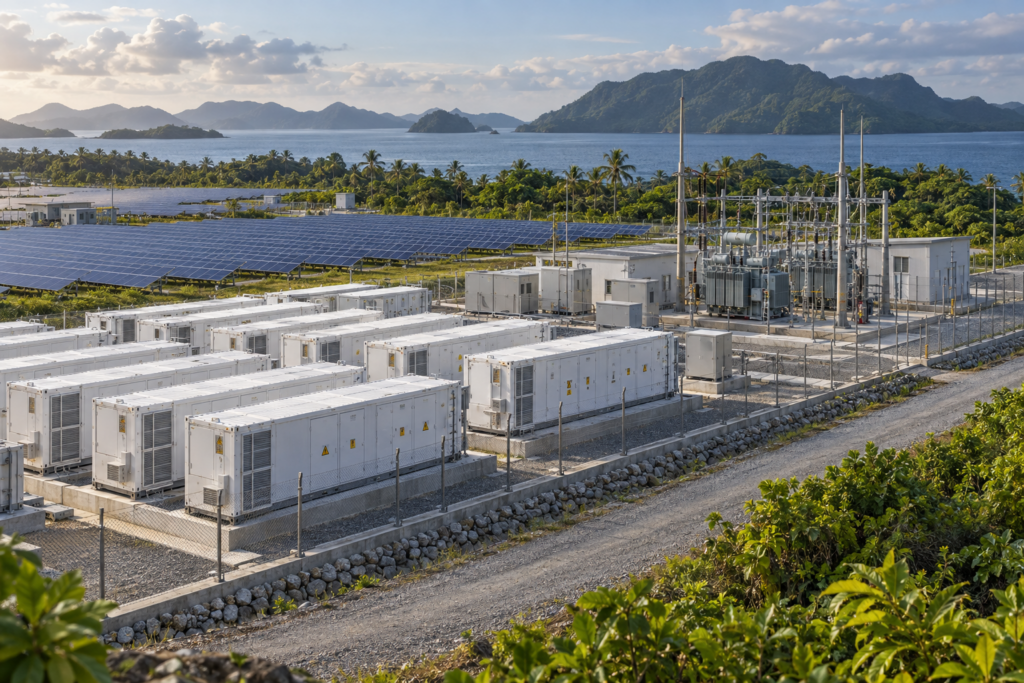
Indonesia’s electricity demand could rise from nearly 500 TWh in 2025 to almost 800 TWh by 2035 under the International Energy Agency’s Stated Policies Scenario. PLN, the state-owned electricity utility, plans to meet that growth with more than new generation. Its 2025-2034 power plan, RUPTL, includes 69 GW of additional capacity, including 6 GW of standalone battery storage and 3.6 GW of solar-plus-storage projects.
Battery energy storage systems, or BESS, can shift solar output into the evening, support frequency and voltage, and reduce diesel use in isolated grids. The engineering case is clear. The financing case depends on something different: a predictable source of revenue that lenders can use to size and repay long-term debt.
In a report published on 3 September, the IEA estimated that the storage portfolio it assessed would require about $5 billion of investment from 2026 to 2034, or nearly $560 million a year. The constraint is not a complete lack of investor interest. It is the limited number of projects with revenue structures that banks can model with confidence.
What PLN is actually paying for
A conventional generator can be paid for each unit of electricity it produces. A battery has a different economic role. It charges at one time and discharges later, with unavoidable energy losses. Its value comes from being available at the right moment, responding quickly and moving electricity across time.
Paying only for energy discharged may not compensate an asset that must remain ready even when the system operator uses it infrequently. Merchant arbitrage is another possible revenue source, but it depends on sufficiently deep and volatile intraday power markets. That is not a reliable standalone assumption for all Indonesian projects.
Cycling also wears the battery. More intensive dispatch today can reduce usable capacity later. A financeable contract therefore needs to define normal operating conditions and compensation when PLN requires additional cycling.
For standalone storage, the IEA examines a full-tolling structure. A private investor finances, builds and maintains the battery, while PLN controls dispatch and pays for contracted availability subject to performance standards. In practical terms, the utility is paying to have a specified amount of storage ready when the grid needs it.
That structure gives lenders a more predictable revenue stream. The IEA estimates that annual availability payments of $111 to $297 per kW could support the returns sought by commercial investors, depending on location, connection costs, project size, financing terms and degradation assumptions. The range is not an approved tariff; it shows how project-specific the economics remain.
Solar-plus-storage projects can use a different model. A long-term power purchase agreement, or PPA, can cover both the generation and storage components. The battery shifts solar output into more valuable hours and makes delivery more predictable, but it increases capital cost. Across the main RUPTL regions, the IEA estimates that storage raises the required PPA price by $8 to $18 per MWh.
Four risks lenders need to price
The first is regulation. Indonesia has a framework for hybrid projects to recover solar and storage costs through PPAs. Standalone batteries still lack equally detailed rules on classification, remuneration and procurement of grid services. A lender cannot forecast revenue confidently if the asset’s regulatory treatment remains uncertain.
The second is degradation. Contracts need measurable commitments for available power and energy, round-trip efficiency, response time and capacity retention. They also need to say who pays when PLN requests more cycling than assumed in the base case. Otherwise, developers must either charge more upfront or offer a narrower performance guarantee.
The third is the offtaker. PLN has investment-grade credit ratings, but operates with regulated tariffs and relies on government subsidies and equity injections. Payments for storage therefore compete with spending on generation, transmission, distribution and electrification. A long-term storage contract must fit PLN’s own financial capacity.
The fourth is currency. Imported equipment and international loans may be denominated in hard currency while PLN’s revenue is largely in rupiah. International banks may bring more technology experience but greater foreign-exchange exposure. Domestic banks match the local currency better but may be more cautious about battery performance. The IEA therefore sees value in syndicated financing that combines both groups.
Why the first projects may need concessional finance
The IEA model assigns about $2.5 billion of the required investment to commercial debt. Roughly $2.3 billion comes from national public sources, including government equity, PT SMI and sovereign funds, while international public financiers provide around $275 million.
The report also estimates a need for about $460 million in grants and concessional loans, close to 10% of the total. The purpose is not to subsidise storage indefinitely. Concessional capital is most useful where early projects face risks that commercial lenders still price very heavily: uncertain revenue, expensive currency hedging, first-of-a-kind construction risk or small systems on remote islands.
For the first standalone batteries, replacing part of commercial debt with concessional funding could reduce the required availability payment by around 6%, according to the IEA. That can lower the initial cost to PLN while projects build a performance and payment record.
Support should then decline. If concessional finance permanently compensates for unclear regulation or weak contracts, it masks the problem instead of creating a commercial market. Successful projects should generate standard contract terms, operating data and a refinancing track record.
Cheaper batteries do not remove contract risk
The IEA estimates a weighted average cost of capital of 9-11% for Indonesian BESS projects. That figure reflects the combined cost of debt and equity. Falling cell prices reduce capital expenditure, but they do not determine who pays for standby capability, who absorbs foreign-exchange losses or how accelerated cycling is treated.
The first projects therefore have to prove the commercial model as well as the technology. Standalone systems in Java, Madura and Bali can show how grid services are measured and paid. Hybrid systems in Sulawesi and isolated grids can demonstrate the economics of replacing diesel with stored solar generation.