

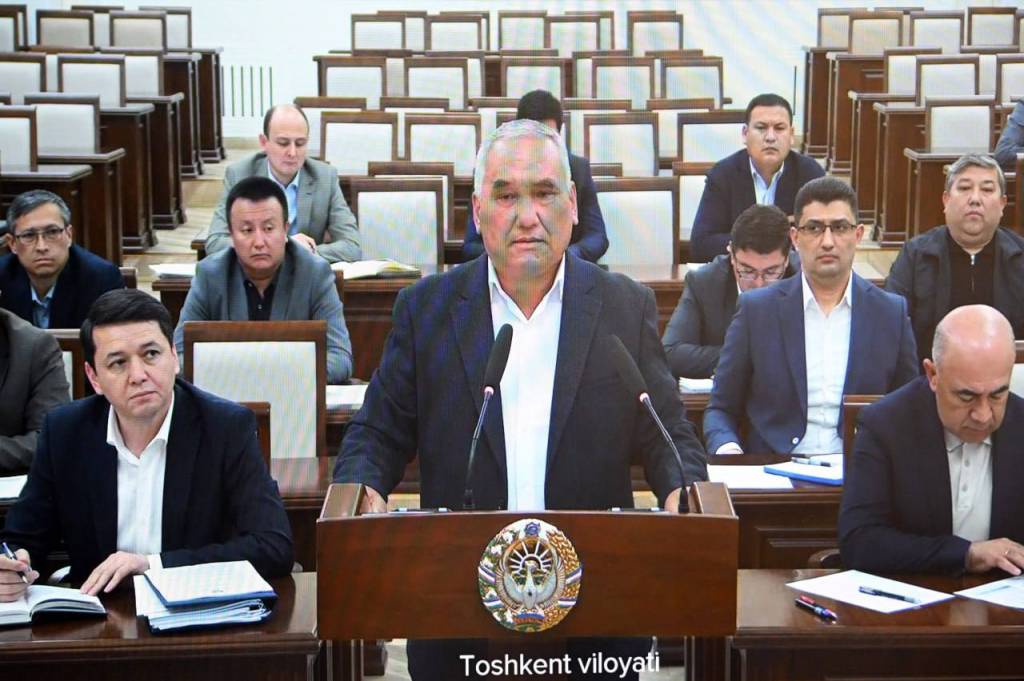
On March 17, President Shavkat Mirziyoyev held a virtual conference to discuss improvements in drinking water supply, heating systems, mahalla landscaping, and agriculture.
Efforts to enhance the quality of life for the population are continuously expanding. This year, the goal is to lay 1,619 kilometers of water supply networks and 521 kilometers of sewage networks, as well as construct and reconstruct 162 infrastructure facilities. This will provide access to clean drinking water for 715,000 people, connect 135,000 households to sewage systems, and install modern metering devices for 157,000 consumers.
During the recent visit of the Head of State to France, agreements were made to implement three water supply projects in Surkhandarya and Kashkadarya regions, with a total cost of 340 million euros. The French company Suez will manage the drinking water systems in Denau, Shurchi, Sariasiya, and Kumkurgan, aiming to increase the centralized water supply coverage in the region to 90 percent.
Sewage systems are crucial for the development of construction, industry, and the service sector. Each year, trillions of soums are allocated from the state budget to expand these systems. However, it is also necessary to involve the private sector actively in this field.
For instance, with the support of the Asian Development Bank, a local entrepreneur is building wastewater treatment facilities in Almalyk, Bekabad, Angren, and Chirchik. Another entrepreneur has proposed taking over the private management of water supply and sewage services in two districts of Andijan region.
The importance of expanding public-private partnerships and creating more opportunities for local companies to participate in international tenders was emphasized.
A decision was made to simplify the implementation of projects involving international financial institutions. Instructions were issued to expedite tender procedures, with plans to complete projects worth $850 million by the end of this year.
Digitalizing the utilities sector is another important task. In this regard, $125 million will be attracted from the Asian Development Bank. Over the next five years, 4,800 smart meters and 2,800 telemetry systems will be installed at major hydraulic structures and main pipelines.
This initiative will create significant market opportunities for the electrical engineering industry. Instructions have been issued to gradually transfer meter maintenance services to the private sector.

Heating supply is one of the most gas-intensive sectors. Therefore, on March 11, the President signed a resolution to initiate comprehensive reforms in the heating sector and improve energy efficiency. According to the resolution, a single company, Issiqlik Ta’minoti, has been established, bringing together 23 regional heating supply organizations. Over the next five years, 19 trillion UZS will be invested in restoring and modernizing heating supply systems. This will increase the coverage of centralized heating supply from 37% to 58%.
The Ministry of Construction and Housing and Communal Services has been tasked with developing a program to enhance energy efficiency in apartment buildings and social institutions. It was noted that 9,000 residential buildings and social facilities will transition to a closed-loop heating system. This measure is expected to reduce heat loss by half and cut gas consumption by 20%.
The meeting also addressed issues related to spring planting, including measures aimed at simplifying land allocation from the reserve funds of local hokimiyats.
From now on, installment sales of agricultural land through auctions will be discontinued. The price of unsold lots will decrease by 10% daily. If only one participant is present at the subsequent auction, they will automatically be declared the winner. Additionally, 10 to 20% of allocated lands will be dedicated to cultivating fodder crops for livestock breeding.

Currently, the activities of over 93,000 farmers are evaluated based on an entrepreneur rating system. This rating will now be divided into distinct indicators, such as productivity, employee numbers, and production volumes.
Farmers with high-performance ratings will no longer be required to insure against loan default risks. Additionally, their land tax will be reduced threefold, and membership fees to the Farmers’ Council will be halved. Farmers who achieve above-average harvests in cotton and grain crops will be permitted to utilize up to 25% of their land for crop rotation with fodder plants, vegetables, legumes, and other crops.
The meeting also addressed ongoing efforts to develop household gardening and mahalla landscaping as part of the month-long landscaping initiative announced by Presidential decree.
This spring, 125 million seedlings will be planted. The President emphasized the importance of properly selecting planting locations and enhancing irrigation systems. In particular, water reservoirs with geomembrane lining will be constructed in mahallas with limited water supply.
Last year, 208 mahallas launched pilot projects to establish local service companies that provide residents with 23 different types of services. This year, the initiative will be significantly expanded, with plans to create an additional 1,000 such companies and increase the range of offered services to 30. Additionally, based on Chinese expertise, 5,000 specialists will undergo training for mahalla maintenance, creating employment opportunities for approximately 15,000 individuals.
From this year onward, special units dedicated to maintaining internal roads have been established within the public improvement departments of 208 districts and cities. An additional 700 billion UZS have been allocated to acquire specialized equipment. Instructions have also been issued for repairing internal roads and improving the electricity supply in mahallas.
The meeting included reports from Deputy Prime Ministers, Ministers, and hokims.
UzA