

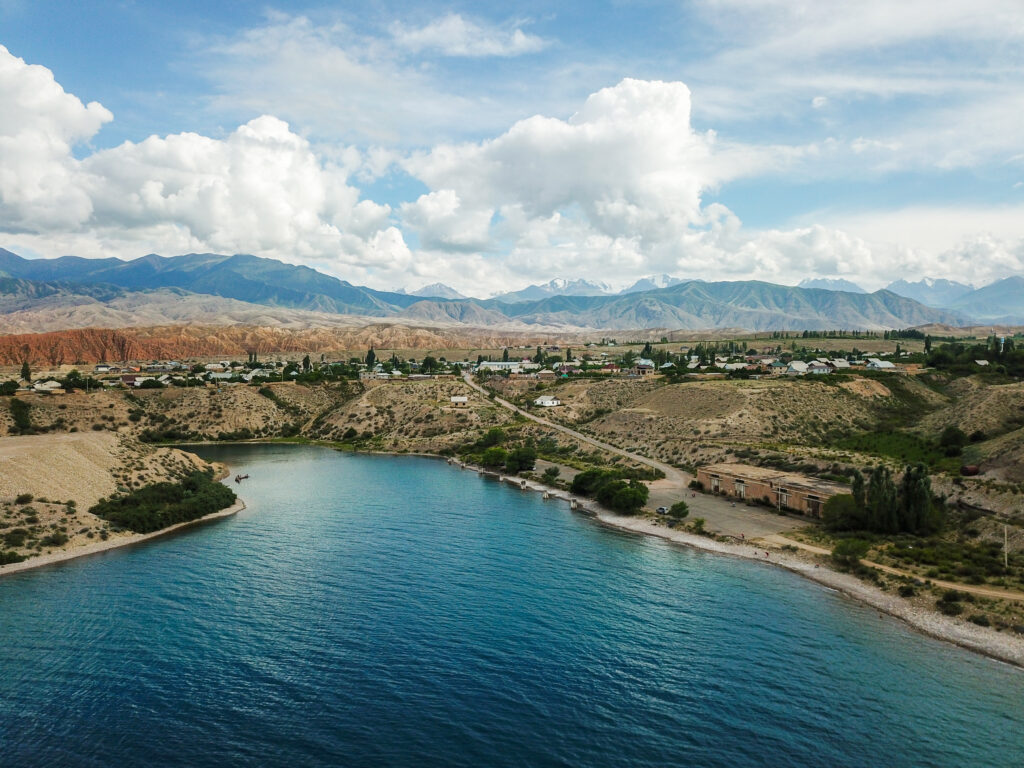
Water has always shaped Central Asia’s economic geography, but its role is now becoming more strategic and more fragile. Rivers flowing from the Tien Shan and Pamir mountain systems support agriculture, hydropower, food production, drinking water systems, and industrial activity across five interconnected states. As climate pressure intensifies, this shared water system is becoming a source of regional economic vulnerability rather than only an environmental concern.
The challenge is no longer limited to the legacy of the Aral Sea disaster or seasonal disputes over water allocation. Central Asia is now facing a wider structural risk linked to glacier loss, demographic growth, inefficient infrastructure, and fragmented governance. Per capita water availability across the region has declined to around 2,500 cubic meters over the past four decades, while the region is warming 1.5–2 times faster than the global average. Glacier loss has already reached approximately 36 percent compared with the Soviet-period baseline, threatening the stability of river runoff systems that support irrigation, hydropower, and food security.
Climate Stress Is Already Affecting GDP
The economic consequences are already visible. Climate change and extreme weather events have reduced the GDP of Central Asian countries by an average of 5.5 percent. Without urgent adaptation, agricultural productivity in parts of the region could decline by up to 30 percent by 2050, while around 5.1 million people may face climate-related displacement driven by water scarcity, falling rural incomes, and repeated environmental shocks.
These figures show why water security must be viewed as a core economic planning issue. Agriculture remains heavily dependent on irrigation systems built during the Soviet period, many of which are no longer efficient enough for today’s climate reality. In Kazakhstan, irrigation efficiency in some systems remains close to 55 percent, while water losses can reach up to 40 percent. For businesses, investors, and policymakers, this means that water risk is becoming directly linked to productivity, infrastructure costs, food prices, energy stability, and long-term regional competitiveness.
Transboundary Dependence Creates Systemic Exposure
Central Asia’s water challenge is regional by design. Around 81 percent of the region’s population depends on transboundary water systems originating in the Tien Shan and Pamir-Alai mountains. This creates deep interdependence between upstream countries, which control much of the water source and hydropower potential, and downstream economies, which depend on reliable flows for agriculture, cities, and industry.
The exposure is especially high in downstream states. External water dependency reaches up to 97 percent in Turkmenistan and around 80 percent in Uzbekistan. At the same time, Kyrgyzstan forms approximately 47 percent of the Syr Darya river flow through the Naryn and Kara Darya systems, yet receives less than 2 percent of distributed basin runoff under existing allocation structures. This imbalance highlights a long-term governance challenge: the costs, benefits, and responsibilities of regional water use are not fully aligned.
Drought Is a Regional Stress Test
Drought risk is becoming one of the clearest indicators of systemic vulnerability. Around 30 percent of Central Asia faces a drought probability of 50 percent or higher, while severe drought events recur in some countries every 5–6 years. Up to 70 percent of emergency-related impacts in the region are linked to drought conditions, which means that water scarcity increasingly affects not only ecosystems but also electricity systems, food supply chains, trade flows, and political trust.
The main risk is that climate shocks can spread quickly across borders through shared river basins and interconnected water-energy systems. During low-water years, unilateral domestic responses may create downstream consequences for neighboring countries. Fragmented monitoring systems, weak data-sharing practices, and the absence of fully operational regional drought protocols make coordinated response more difficult. As a result, drought is not only a weather event; it is a test of institutional resilience.
Financing the Transition Remains a Major Challenge
Central Asia faces an estimated annual water-sector financing gap of $2 billion to $2.6 billion. This gap covers the modernization of irrigation networks, hydrometeorological systems, digital water management, storage infrastructure, and climate-resilient planning. Without stronger investment, outdated infrastructure will continue to increase losses and weaken the region’s ability to adapt to more frequent climate shocks.
The broader climate-finance challenge is even larger. Uzbekistan’s annual climate-finance needs are estimated at between $15.7 billion and $34 billion, largely concentrated in the energy sector. At the same time, Central Asia loses at least $4.5 billion in unrealized income every year due to insufficient cooperation in the water sector, while the economic gains from expanded regional electricity trade could exceed $15 billion. These numbers show that better coordination is not only a diplomatic priority but also a measurable economic opportunity.
Adaptation Is Now an Infrastructure Strategy
Climate adaptation in Central Asia is moving from policy discussion to infrastructure redesign. Resilience must be built into irrigation systems, hydropower facilities, reservoirs, transport corridors, urban planning, and regional monitoring platforms. Nature-based solutions such as watershed restoration, wetland recovery, reforestation, and ecosystem-based reservoir management can also reduce long-term exposure to floods, droughts, extreme heat, and glacier-related hazards.
For the region, the most important vulnerability may be institutional rather than purely hydrological. Shared data, predictable allocation rules, water-energy exchange mechanisms, basin-level emergency protocols, and joint financing tools will define how well Central Asia can manage future climate stress. Water scarcity is now linked to food security, electricity stability, migration pressure, industrial development, fiscal sustainability, and regional trade. In this context, water is becoming one of Central Asia’s most important economic indicators and one of its most urgent strategic challenges.