

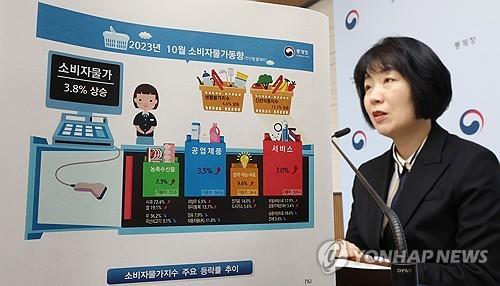
Data released on Thursday showed that South Korea’s inflation rate increased to 3.8 percent in October, staying above 3 percent for the third consecutive month. This is due to higher prices of energy and farm goods.
Consumer prices, a key measure of inflation, rose 3.8 percent on-year in October, up from a 3.7 percent increase the month before. This marks the third month in a row that the annual price growth has increased, although it had been gradually moderating since April.
Core inflation, which excludes volatile food and energy prices, rose 3.6 percent on-year in October, slowing from the previous month’s 3.8 percent growth.
Prices of daily necessities, such as food, clothing and housing, climbed 4.6 percent on-year in October, accelerating from a 4.4 percent rise the month before.
Agricultural, livestock and fishery products prices jumped 7.3 percent last month, with vegetables surging 13.5 percent, the highest in 29 months.
Utility services reported a 9.6 percent on-year price increase in October due to high global energy prices. Prices of industrial products added 3.5 percent, mainly due to higher gasoline and clothing costs.
The service sector also reported a 3 percent on-year advance in prices last month on higher insurance and house management costs.
Finance Minister Choo Kyung-ho said, “Inflation is expected to ease at a slower pace than expected due to geopolitical risks from the Middle East, abnormal weather conditions and other factors. The government will put priority on the stabilization of prices and activate a special scheme involving all relevant ministries.”
The finance ministry said that inflationary pressure is expected to cool down on the rising agricultural output in autumn, though the growth rate will stay over 3 percent through the end of this year.
South Korea is unlikely to achieve this year’s inflation target of 3.3 percent, as the figure during the first 10 months of 2023 came to 3.7 percent. The Bank of Korea (BOK) set its target inflation rate at 2 percent.