


(ATTN: ADDS details in last 4 paras)
SEOUL, Nov. 8 (Yonhap) — Despite high borrowing costs, household loans extended by banks in South Korea increased for the seventh consecutive month in October, according to data from the Bank of Korea (BOK).
Banks’ outstanding household loans had come to 1,086.6 trillion won (US$833.6 billion) as of end-October, up 6.8 trillion won from a month earlier.
The October gain was higher than the 4.8 trillion-won rise the previous month and marks an on-month rise for the seventh month in a row, the data showed.
Banks’ home-backed loans rose 5.8 trillion won to 839.6 trillion won last month, slowing from a 6.1 trillion won on-month gain the previous month, while unsecured and other types of loans rose 1 trillion won to 245.7 trillion won over the cited period, according to the data.
Borrowing costs in South Korea remain high following the BOK’s aggressive monetary tightening aimed at bringing surging inflation under control.
Despite rate freezes in February, April, May, July and August, and the BOK’s decision to hold its key interest rate steady at 3.5 percent for the sixth straight time early this month, household debt continues to put pressure on the economy.
Last year, outstanding household loans slipped for the first time in 18 years due to higher rates.
Banks’ loans to companies also continued to rise amid high demand.
Corporate loans extended by banks rose 8.1 trillion won last month, slowing from an 11.3 trillion won rise the previous month, a record for any September since the central bank began to compile related data on a monthly basis in June 2009, the data showed.
The Financial Services Commission (FSC) said it will continue to monitor the growth of household loans and announced plans to temporarily forgive early termination fees on household loans as part of efforts to rein in household debt.
It will also seek to expand the application of the debt service ratio (DSR) and introduce a new formula for floating rate stress DSR before the end of next month, according to the FSC.
The DSR measures how much a borrower has to pay for principal and interest in proportion to his or her yearly income, which serves as a ceiling on aggregate lending.
The DSR currently is at 40 percent, meaning the principal and interest payments of any borrower cannot exceed 40 percent of their annual income.
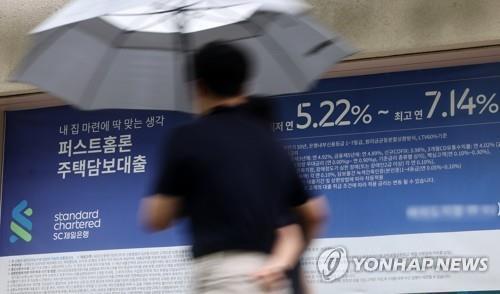
This file photo, taken July 18, 2023, shows information about a bank's loan programs in Seoul. (Yonhap)
sam@yna.co.kr
(END)
Related Articles (2nd LD) S. Korea’s inflation grows faster, stays over 3 pct for third month in Oct. (2nd LD) Korea’s Q3 growth beats estimate on exports; outlook still murky BOK chief says to keep restrictive policy for considerable time