

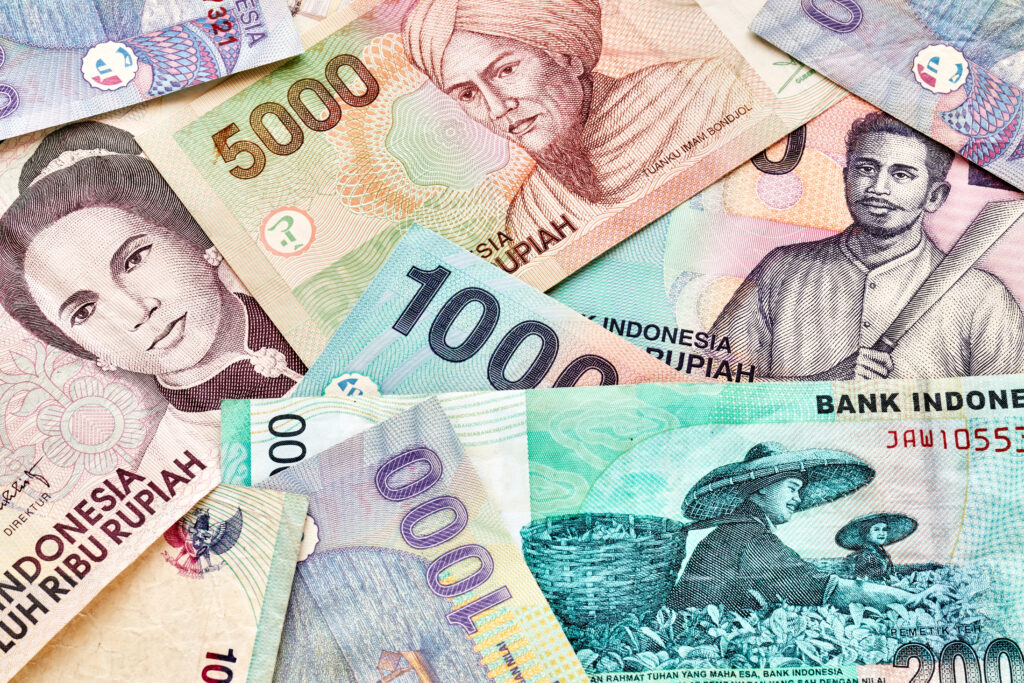
Indonesia’s rupiah has reached a new record low, highlighting the growing pressure on Southeast Asia’s largest economy. The currency briefly touched 17,670 per U.S. dollar after falling as much as 1.2% in one trading session. Although it recovered slightly before the market closed, the move marked another stage in a prolonged period of depreciation.
The decline came after a four-day holiday weekend, when local markets reopened to a difficult external environment. Global oil prices had risen to a two-week high, adding pressure to Indonesia’s import bill and external balance. At the same time, Jakarta’s main stock index fell by more than 4%, reflecting a broader loss of investor confidence.
The rupiah has now depreciated by more than 14% since October 2024, when President Prabowo Subianto took office. Its current level is weaker against the U.S. dollar than during the Asian financial crisis of 1997–1998. This comparison is important because it shows that currency pressure is not only a short-term market reaction. It also reflects deeper concerns about external balances, fiscal direction, and policy credibility.
Oil Prices Add External Pressure
The rise in global oil prices is one of the main external factors behind the rupiah’s latest decline. Oil prices climbed by around 3% to a two-week high, increasing pressure on countries that depend on imported energy. For Indonesia, higher oil prices can worsen the current account position and increase demand for foreign currency.
A persistent current account deficit remains one of the key structural risks for the rupiah. Markets often read such deficits as a signal that a country may face greater difficulty meeting its external liabilities. In Indonesia’s case, this concern has become more visible as the currency has weakened and foreign exchange reserves have declined.
Bank Indonesia has already used part of its reserves to support the rupiah. The country’s foreign exchange reserves have fallen by around $10 billion so far this year. Despite this, the central bank has stated that reserve levels remain sufficient to maintain stability. It also expects the rupiah to strengthen from July 2026 and continue improving during the second half of the year.
Stock Market Transparency Under Scrutiny
Currency weakness is not the only issue affecting investor sentiment. Indonesia’s equity market is also under close review. MSCI recently removed six companies from its Indonesia Index and another 13 companies from its small-cap index list. This decision followed earlier concerns about market transparency, concentrated ownership, and the limited free float of tradeable shares.
These issues are important for international investors. Index inclusion affects capital flows, liquidity, and the perception of market quality. When a major index provider raises concerns, the impact can go beyond individual companies. It can influence how investors assess the entire market.
In January 2026, MSCI also warned that Indonesia could be downgraded to frontier market status. Such a move would be significant. It could reduce Indonesia’s visibility among emerging market investors and increase the cost of attracting portfolio capital. The recent sell-off in Jakarta’s stock market shows how sensitive investors have become to governance and transparency risks.
Policy Credibility Becomes a Market Factor
Indonesia’s economic fundamentals remain substantial. The country has a large domestic market, strategic resources, and a central position in Southeast Asia. However, markets are now paying closer attention to the quality and predictability of policymaking.
Recent downgrades by Moody’s and Fitch have added to these concerns. Fitch pointed to rising policy uncertainty and weaker consistency in the policy mix. These signals matter because credit ratings influence borrowing costs, investor sentiment, and long-term capital allocation.
The Prabowo administration has also introduced expensive social programs. While such measures may support domestic demand and social stability, they can raise questions about fiscal discipline if not matched by strong revenue and clear financing plans. For investors, the key issue is not only the size of spending but also the credibility of the broader economic framework.
What This Means for Regional Markets
Indonesia’s current situation offers a wider lesson for Asian markets. Currency stability depends on more than central bank intervention. It also requires strong external balances, transparent capital markets, credible fiscal policy, and consistent communication with investors.
Bank Indonesia’s expectation of a stronger rupiah from July 2026 may help calm short-term concerns. However, the second half of 2026 will be a critical period. Investors will watch whether oil prices remain elevated, whether foreign exchange reserves stabilize, and whether policy signals become more predictable.
For companies operating in Indonesia or the wider ASEAN region, the main takeaway is clear. Currency risk, equity market governance, and fiscal policy should be assessed together. A weaker rupiah may create challenges for importers, foreign debt borrowers, and companies with dollar-linked costs. At the same time, it may improve competitiveness for some exporters.
Indonesia remains one of Asia’s most important economies. Yet the latest market movements show that scale alone is not enough. Investor confidence depends on transparency, discipline, and the ability to manage external shocks in a consistent way.