

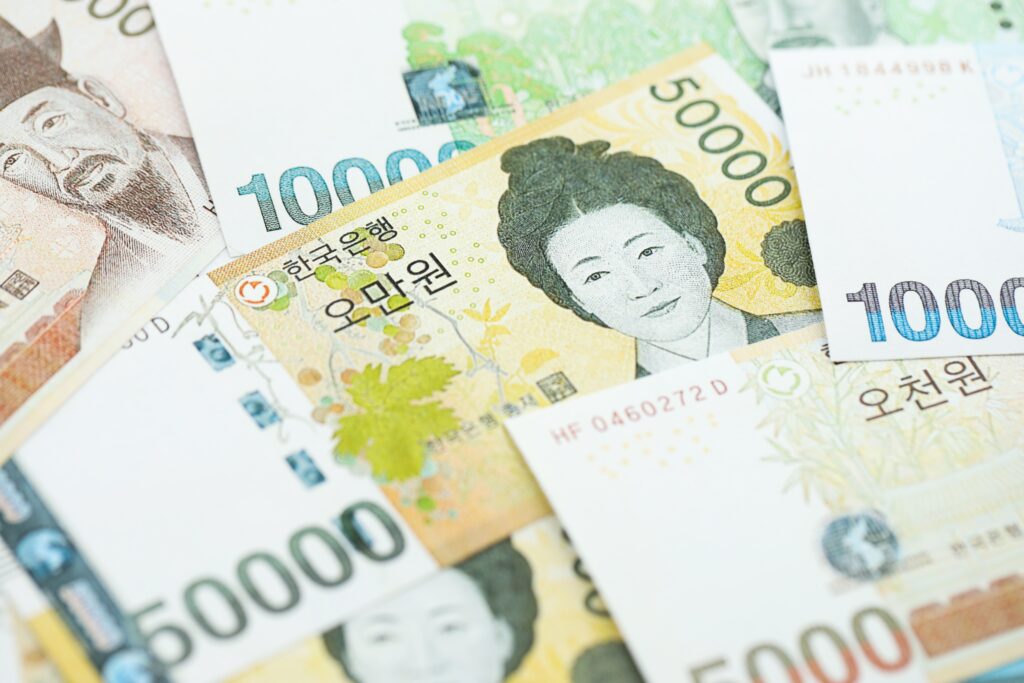
South Korea’s five largest banks are holding a record volume of US dollar deposits even as the won strengthens sharply. As of September 3, corporate and retail customers held $76.98 billion in dollar accounts, the highest level since comparable data began in May 2021. Balances increased by more than $6.9 billion in August and by another roughly $600 million during the first three days of September. In practice, foreign-currency deposits serve several purposes. Exporters hold overseas revenue, importers build reserves for future payments, and private investors prepare funds for purchases of foreign securities. The record therefore reflects a change in currency management rather than a flight from the won.
A Stronger Won Is Changing Corporate Behaviour
The exchange-rate move has been unusually fast. On September 4, the dollar traded at 1,345 won, its lowest level since early October 2024, compared with an intraday peak of 1,599.2 won on July 1. The dollar fell 8.09% against the won in July, its steepest monthly decline in almost 17 years. It declined another 3.89% in August, taking the two-month fall to 11.67%. Yet corporate dollar deposits reached $63.30 billion, more than 82% of the total, while retail deposits stood at $13.68 billion, their highest level since February 2022. The figures point primarily to corporate cash-flow management.
For exporters, the incentive is clear. Companies in semiconductors, automobiles and shipbuilding earn large amounts in foreign currencies while paying many domestic expenses in won. When the won is weak, converting dollar revenue produces more local currency. After a rapid appreciation, the same dollar converts into fewer won, giving exporters a reason to delay conversion if immediate expenses are covered. That can reduce dollar supply on the domestic market and slow further won appreciation. Importers face the opposite calculation. A stronger won makes dollar-denominated purchases cheaper, encouraging refiners, airlines and manufacturers to buy currency ahead of future payments for energy, equipment and components. The stronger the won becomes, the more attractive it can be for some market participants to accumulate dollars.
Overseas Investment Weakens the Traditional Trade-Currency Link
Retail investors are reinforcing the trend. In August, private customers at the five largest banks exchanged $389 million into dollars, the highest monthly amount since January, while conversions from dollars back into won were only about one-third of that level. During the first three days of September, dollar purchases reached around $60 million. A growing share is connected to US equities and other foreign assets. A stronger won lowers the entry cost of buying the same dollar-denominated investment, making foreign-currency accounts a staging point for overseas allocation.
This also explains why a large external surplus no longer guarantees a stronger currency. South Korea recorded a July current-account surplus of $42.08 billion, the highest ever for that month and the second-largest monthly result on record after $49.73 billion in June. The surplus had remained positive for 39 consecutive months, supported particularly by semiconductor exports. Yet export earnings do not always return immediately to the domestic foreign-exchange market. Companies may leave profits abroad, reinvest them in production, or retain export proceeds in dollar accounts. The Bank of Korea estimates that around 40% of profits from overseas investments are reinvested abroad. As South Korea becomes both a major exporter and a major owner of foreign assets, capital allocation increasingly matters alongside trade flows.
What the Shift Means for the Won
The policy challenge is therefore less about defending a specific exchange rate and more about limiting abrupt one-way moves. On August 27, the Bank of Korea raised its policy rate by 0.25 percentage points, from 2.75% to 3%, citing persistent inflation, stronger-than-expected growth, rising housing prices and increasing household debt. Higher rates can support the won, but monetary policy also affects consumption, housing and investment. Three broad scenarios follow. Further won appreciation could encourage more dollar buying by importers and investors while exporters delay conversions, naturally slowing the move. Stabilisation near current levels would allow companies to rebalance purchases and sales. A renewed weakening of the won could instead accelerate dollar demand and amplify the reversal.
The broader conclusion is that South Korea’s currency market is becoming more complex. Record dollar deposits, a stronger won and a large current-account surplus can coexist because they reflect different decisions by exporters, importers, investors and households. Exporters cannot assume that a weaker won will quickly return, importers cannot treat the current appreciation as permanent, and investors still face both asset-price and exchange-rate risk. The record $76.98 billion in dollar deposits is therefore more than a savings story. It is a signal that the Korean economy is increasingly managing trade income, liquidity and investment flows on a global balance sheet.