

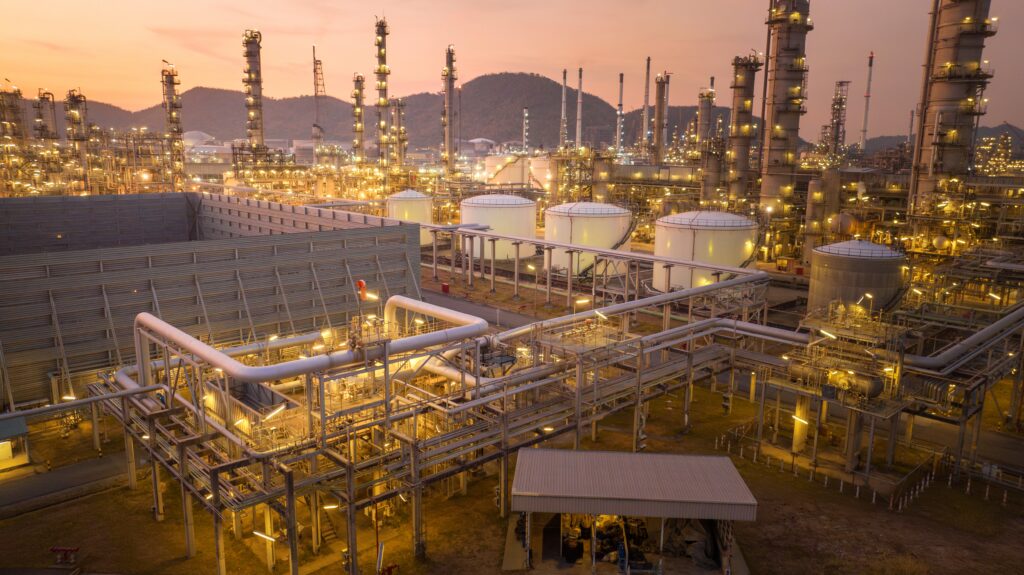
INEOS announced on 22 September 2026 that it was suspending operations at three chemical production units in Hull, with two already stopped and the third expected to follow within days. The facilities produce acetic acid, acetic anhydride and ethyl acetate, intermediate chemicals used across pharmaceuticals, textiles, food production, construction, coatings and other industrial value chains.
Their annual capacities are substantial: approximately 500,000 tonnes of acetic acid, 150,000 tonnes of acetic anhydride and 200,000 tonnes of ethyl acetate. The immediate issue is therefore larger than the future of three individual production units. It highlights how energy costs, weaker demand, environmental compliance expenses and international competition are changing the economics of European chemical manufacturing.
Gas Prices Have Become a Structural Cost Problem
INEOS identifies the price of natural gas as one of the central reasons for suspending production. Gas is particularly important for basic chemicals because it is not simply an energy source used to generate heat and steam. It can also function as a feedstock, meaning that rising prices affect both the operation of a plant and the cost of its raw materials.
INEOS estimates that European gas currently costs around 12 times more than in the United States, although this figure reflects the company’s assessment of current market conditions rather than a universal long-term industrial price comparison. Broader industry indicators nevertheless confirm a significant competitiveness gap. From January to April 2026, European Union gas prices averaged approximately 3.3 times US levels, while European industrial gas and electricity prices have remained considerably higher than those of major trading partners.
Part of this difference reflects the transformation of Europe’s energy system. Following the sharp reduction in Russian pipeline supplies, Europe significantly increased its dependence on liquefied natural gas. LNG accounted for about 20% of EU gas imports in 2021, rising to approximately 45% in 2025.
In 2025, the United States supplied around 26% of total EU gas imports, while Norway accounted for roughly 31%. This restructuring strengthened security of supply, but LNG requires liquefaction, shipping and regasification, while European buyers must also compete with Asian demand. Europe has therefore reduced the risk of physical gas shortages without necessarily restoring the cost conditions that previously supported energy-intensive manufacturing.
The Hull Case Reflects a Wider Industrial Trend
The pressure is already visible across the European chemical sector. In the second quarter of 2026, EU chemical industry capacity utilisation stood at around 75%, significantly below its long-term average. Chemical exports fell 6.3% in value terms during the first half of the year, while imports declined 5.9%.
Meanwhile, European steam-cracking capacity has fallen by approximately 15% since 2021, and ammonia capacity by around 9%. These figures point to a difficult combination: plants are operating below optimal utilisation while facing expensive energy and feedstocks, weak demand and competition from regions with structurally lower production costs.
Low utilisation can intensify the problem. Fixed costs must be distributed across fewer tonnes of output, increasing the cost of every unit produced. Higher gas prices add another layer of pressure, while competitively priced imports restrict the ability of producers to pass additional expenses to customers.
This helps explain why technically efficient facilities can still become commercially difficult to operate. The challenge is also increasingly investment-related. New or modernised European chemical plants may require spending on electrification, hydrogen, carbon capture, network connections and emissions reductions. If expected returns are more attractive in the United States, the Middle East or Asia, new capital can follow production out of Europe.
Import Dependence Creates a Different Type of Risk
Suspending European capacity does not automatically mean shortages. International producers can supply many of the same chemicals, and imported products may sometimes be cheaper. However, a larger dependence on external supply creates exposure to shipping disruption, trade restrictions, logistics costs and changes in global demand.
For industries such as pharmaceuticals, food manufacturing and defence, continuity of supply can be as important as the lowest available price. INEOS estimates that its Hull operations support almost 4,000 jobs when contractors and associated businesses are included, although approximately 240 employees are reported as working directly at the three affected plants. The wider economic effect of prolonged closures could therefore extend through transport providers, maintenance companies, laboratories, equipment suppliers and shared industrial infrastructure.
The environmental equation is also complex. INEOS estimates that comparable US production has around twice the carbon footprint of its Hull production and Chinese production around eight times the footprint, although detailed calculations supporting those figures were not published alongside the announcement.
The broader issue remains important: if lower-emission European capacity closes and production moves to regions with more carbon-intensive energy systems, territorial European emissions may fall without producing an equivalent reduction in global emissions.
Europe’s Industrial Policy Faces a Strategic Choice
The Hull suspensions demonstrate that energy security and industrial competitiveness are not the same objective. Europe has made significant progress in diversifying gas supplies, but energy-intensive industries still operate with a substantial cost disadvantage.
Temporary assistance can help plants through price spikes, but long-term competitiveness depends on more predictable energy costs, investment conditions, infrastructure, carbon policy and demand for lower-emission production. The central question is not whether every existing plant should be preserved. It is whether strategically important, competitive chemical capacity can remain economically viable while Europe simultaneously pursues decarbonisation and greater supply-chain resilience.
The final status of the Hull facilities is not yet determined, and suspension leaves open the possibility of restarting production. But the decision itself is significant.
Once industrial capacity remains offline for an extended period, skilled employees move elsewhere, customers establish new supply agreements and restarting becomes increasingly expensive. For European chemicals, the next stage of the competitiveness debate will therefore be determined not only by gas prices, but by whether energy, trade, climate and industrial policies can operate as parts of the same strategy.