

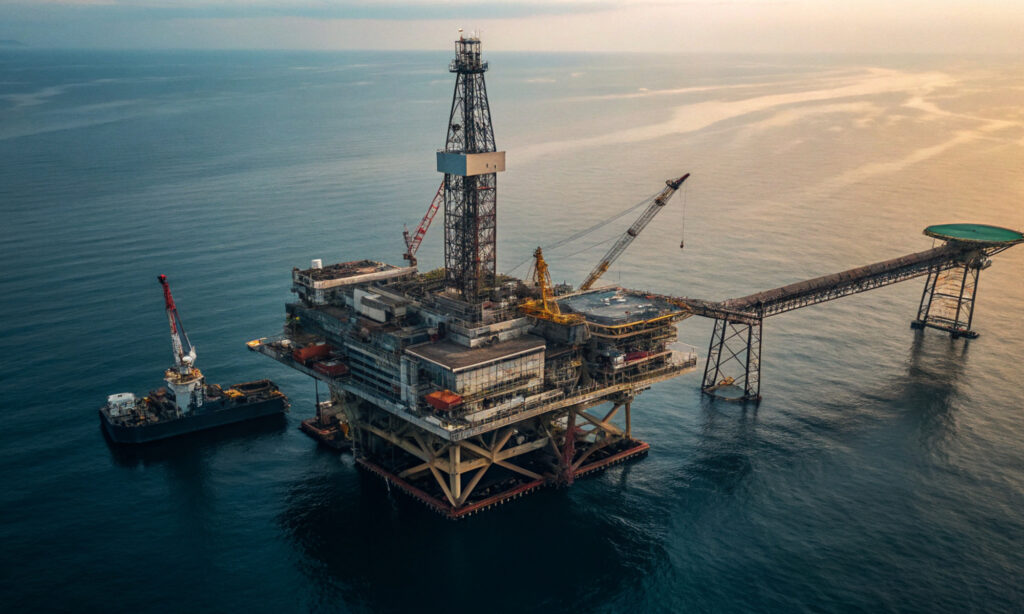
BP has started selling its oil and gas business in the UK North Sea, opening the way for the company to end more than 60 years of production in a major British energy region. The decision may look like a routine portfolio adjustment. In reality, it reflects a wider conflict between national energy priorities and global capital allocation.
BP entered the North Sea in 1964 and made the Forties discovery in 1970. The assets offered for sale include five production hubs, around 1,100 employees, and interests linked to Clair Ridge and Schiehallion near the Shetland Islands. In 2025, the portfolio was estimated to produce roughly 100,000–117,000 barrels of oil equivalent per day.
A Major Asset, but No Longer a Priority
For a specialised producer, this output remains substantial. For a global energy group, scale alone is not enough. BP must compare the North Sea with larger international projects, trading, refining, retail, aviation fuel, and other businesses competing for capital.
The company is not leaving the United Kingdom entirely. It plans to retain its London headquarters, trading activities, retail network, and aviation fuel operations. The shift is therefore a change in the type of exposure BP is prepared to maintain.
Capital-intensive production in a mature basin offers less flexibility. Future returns depend heavily on taxation, licensing, operating costs, decommissioning liabilities, and political support. Less capital-intensive activities can adapt faster and generate returns with lower long-term risk.
The Economics of a Mature Basin
The North Sea has supported British employment, tax revenues, engineering expertise, and energy security for decades. Yet its maturity increasingly shapes its economics. The largest and easiest reserves have already been developed. New projects require more capital, while older fields need continued spending to sustain output and eventually close infrastructure safely.
Since offshore production began, 47.7 billion barrels of oil equivalent have been extracted from the UK continental shelf. Proven remaining reserves were estimated at about 2.9 billion barrels of oil equivalent at the end of 2024.
The region still holds additional resources. The challenge is converting them into commercial production. That requires stable tax rules, licensing clarity, infrastructure access, and confidence that projects will remain politically acceptable throughout their investment cycle.
Tax Policy Has Become an Investment Risk
Higher taxation on North Sea producers followed the surge in energy prices. From a public-finance perspective, the logic is clear: governments expect to capture part of exceptional profits. For investors, rapidly changing tax conditions can weaken confidence in projects that take years to approve and decades to repay.
This problem is more serious in a mature basin. When geological potential is lower and operating costs are higher, even a modest deterioration in fiscal terms can change the investment decision. A project only needs to offer a weaker risk-adjusted return than alternatives elsewhere.
BP’s sale can therefore be seen as an effort to reduce uncertainty and simplify its portfolio. A smaller, specialised operator may accept lower returns, manage mature fields more intensively, and extend production longer. The same assets may still create value under a different ownership model.
Energy Security and Climate Policy Are Diverging
The UK still depends on oil and gas for transport, heating, industry, and petrochemicals. At the same time, long-term policy aims to reduce emissions and accelerate low-carbon energy. Companies receive two messages: domestic production remains necessary, but its political future is limited.
For investors, prolonged uncertainty can be more damaging than a clear restriction. It raises the cost of capital, delays projects, and encourages companies to invest in jurisdictions with more predictable rules.
The sale also raises questions about the buyer. Previous discussions reportedly valued a possible transaction at close to £2 billion, while broader estimates placed the portfolio’s value at several billion dollars. The final economics will depend on prices, taxes, operating costs, and decommissioning obligations.
Three Possible Paths Forward
The first scenario is a controlled transfer to a specialised operator, with production and most employment preserved. The second is accelerated decline, as investment weakens and the UK becomes more dependent on imports while domestic demand remains. The third is a new policy compromise supporting limited production during the energy transition through clearer tax and licensing rules.
BP’s decision is not evidence that oil and gas have suddenly lost relevance. It shows that the old model is becoming harder to sustain. Governments want domestic supply, tax revenue, affordable energy, employment, and rapid decarbonisation. Investors want predictable rules, competitive returns, and manageable political risk.
The North Sea remains strategically important. What it may be losing is its status as an attractive core asset for the world’s largest energy companies. That quieter change could have lasting consequences for the UK’s industrial base, energy security, and investment environment.