

By Lee Haye-ah
At a meeting with hospital and government officials on Thursday, President Yoon Suk Yeol emphasized the necessity of increasing the number of medical personnel in order to restore essential health services and prepare for South Korea’s aging population. His comments illustrate the government’s dedication to raising the enrollment quota at medical schools, a matter that has caused contention among doctors’ groups.

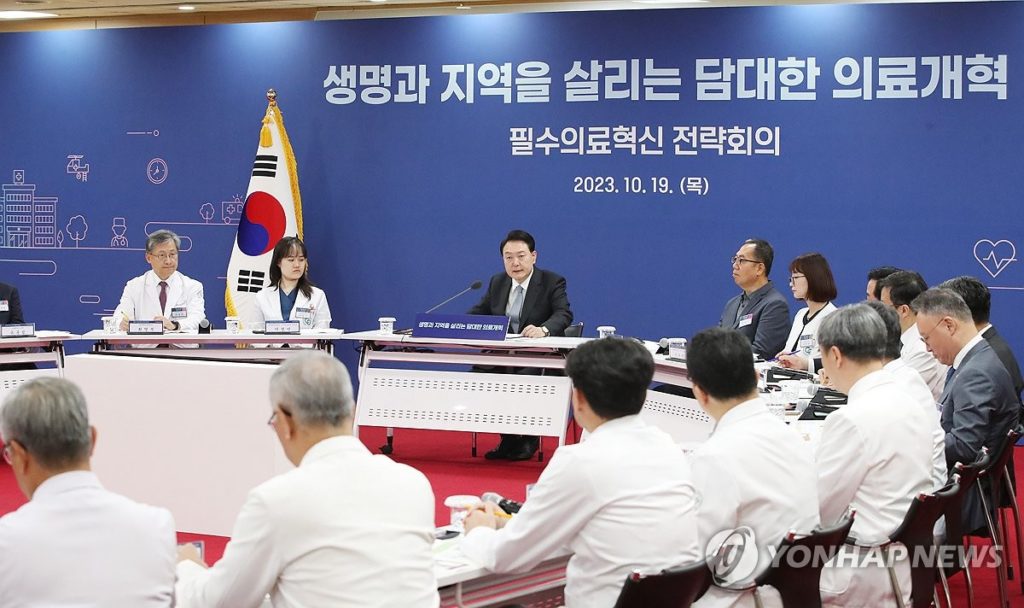
President Yoon Suk Yeol (3rd from L) speaks during a meeting on medical sector reforms at Chungbuk National University in Cheongju, 112 kilometers south of Seoul, on Oct. 19, 2023. (Pool photo) (Yonhap)
“Local and essential medical care, which is vitally connected to people’s health and lives, is in decline,” Yoon said during the gathering at Chungbuk National University in Cheongju, 112 kilometers south of Seoul.
“In order to revive local and essential medical care, and ready ourselves for a super-aged society, expanding medical personnel and training talented individuals are essential,” he added.
The government is reportedly aiming to raise the annual enrollment quota at medical schools by more than 1,000 from the current 3,058, beginning in 2025. This is due to a shortage of doctors providing essential medical services, especially in pediatrics and emergency care. According to the health ministry, the number of doctors per 1,000 people in South Korea is 5.6, much lower than the average of Organization for Economic Cooperation and Development member nations.
However, doctors have been fiercely opposed to the plan, arguing that the government should search for ways to better distribute physicians and raise compensation instead.
“Many people are unable to receive timely treatment due to the shortage of personnel in essential treatment departments, such as pediatrics and obstetrics,” Yoon noted. “The problem of the medical gap between regions has also become very serious.”
He also highlighted the need to develop national university hospitals into a central pillar of the essential medical care system to prevent the collapse of local health services. To this end, he said the government has transferred oversight of national university hospitals from the education ministry to the health ministry.
In addition, Yoon said the government will invest funds to significantly improve the capacity to treat serious illnesses and work to increase personnel in the obstetrics and pediatrics fields by reducing legal risks associated with their practice, adjusting related insurance fees and revising compensation plans.
hague@yna.co.kr
(END)