

On December 10, 2024, stakeholders gathered in Tashkent to discuss the progress of an initiative that is transforming the lives of rural residents. This was the 5th meeting of the joint projects between the Ministry of Economy and Finance and UNDP, known as “Sustainable Rural Development” and “Integrated Rural Development”. These projects are funded by the Islamic Development Bank and the OPEC Fund for International Development. They aim to provide essential services such as improved electricity and water supply, repaired roads, and quality healthcare and education to remote rural areas. Looking back on the achievements of this year, these projects have greatly improved the quality of life in rural areas and are paving the way for a brighter future. 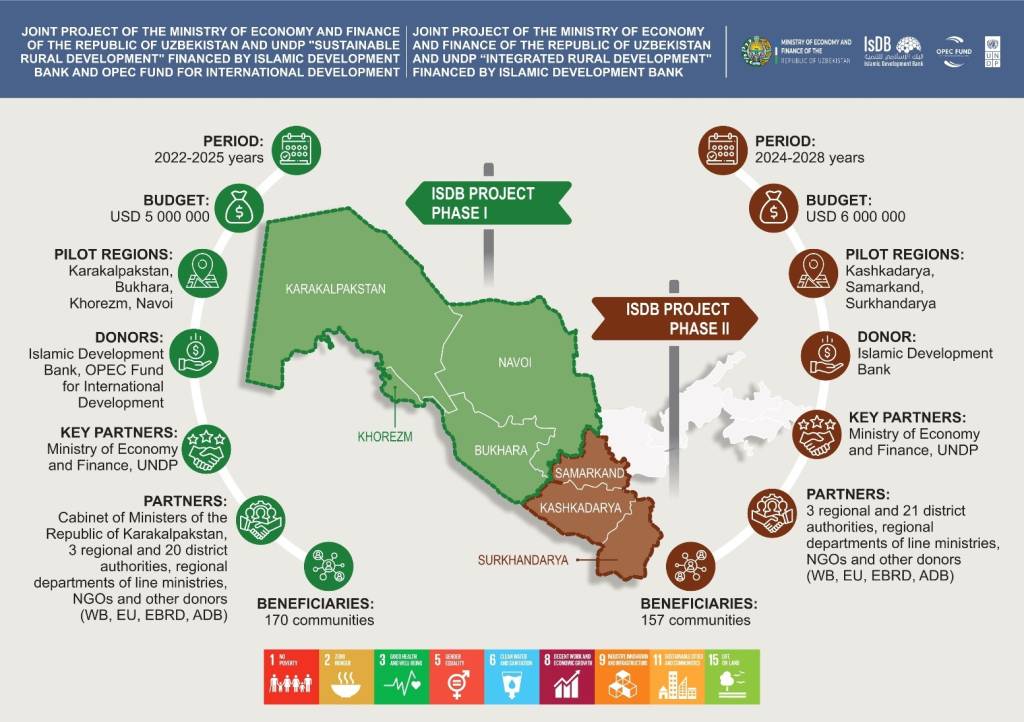
The meeting brought together representatives from various ministries, agencies, local authorities, and international partners to discuss the results of 2024 and plans for 2025.
According to Deputy Minister of Economy and Finance Samandar Sadullayev, “Improving the quality of life in rural areas is a top priority for our country’s development. These projects are among our best, providing real benefits for healthcare and education and contributing to the sustainable development of remote rural regions.”
Sustainable Rural Development (Phase I)
One of the major achievements of the past year was the development of 40 cluster Community Development Plans (CDPs) with active participation from local residents. These plans are not just a list of ideas, but actual roadmaps for implementing 895 subprojects that will improve and build new social infrastructure in Karakalpakstan, Bukhara, Navoi, and Khorezm regions.
From paved roads and improved sewage systems to upgraded healthcare facilities and schools, each subproject reflects the needs and aspirations of the rural people who were actively involved in the planning process. As part of the project, 170 initiative groups were formed in the mahallas, consisting of 1,491 people who monitor the progress of the project’s implementation. Women are also actively involved in this process, contributing to the achievement of gender equality.
The project combines care for people and the planet through joint efforts. For example, propane air conditioners were installed in rural medical points in the Aral Sea region, significantly reducing carbon dioxide emissions. Such initiatives are crucial for the local population, which is already vulnerable to the challenges of climate change. The project also organized training sessions for local specialists on air conditioning system maintenance, promoting greater awareness of the everyday use of household appliances.
Over the past year, 12 different training sessions were held to enhance the potential of the rural population in areas such as agriculture, energy-efficient design and construction, climate change, e-commerce, and accessing government services online. A total of 1,852 people participated in these training sessions.

As UNDP Resident Representative in Uzbekistan Akiko Fujii pointed out, “The project maximizes the potential of digital transformation in rural communities. Thanks to the project, 54,190 residents now have digital access to government services. Furthermore, 8 rural schools have been equipped with new IT resources, including 128 computers and interactive smart boards, opening up new opportunities for the younger generation.”
Integrated Rural Development (Phase II)
Another significant milestone in 2024 was the launch of the second project, which covers 157 mahallas in 21 districts of Samarkand, Kashkadarya, and Surkhandarya regions. The ambitious goals and objectives of this project aim to improve the quality of life of rural residents by 2028.
In a short period of time, a series of important events took place, laying a strong foundation for new changes. Training sessions were conducted in 157 communities across the three pilot regions to engage residents in the project’s implementation process and enable them to actively participate in decision-making for their mahallas. A total of 11,000 people, including 4,413 women, came together to discuss how they could improve their lives. These meetings went beyond just exchanging ideas – they were a moment for making decisions about transforming the mahallas based on the needs and priorities of the population. As a result, 157 initiative groups were formed, consisting of farmers, youth, and entrepreneurs, including 345 women and 15 people with disabilities, highlighting the project’s inclusive approach. These groups will monitor the implementation of subprojects and serve as real drivers of future transformations.
Visual and technical verifications were then made on the proposed facilities, confirming 780 subprojects for inclusion in the CDPs. Every detail was discussed in meetings with local authorities and representatives from ministries and agencies, and each step was carefully considered and coordinated. The result of these joint efforts was the development of 41 CDPs, which focused on gender equality and environmental sustainability. These key documents reflect the dreams and goals of the residents who were part of this large-scale process.

UzA