

On January 4, President Shavkat Mirziyoyev was presented with ideas to improve water use efficiency in agriculture. As the nation faces a growing water shortage, the importance of using water resources wisely and carefully is stressed. In the past few years, 472,000 and 48,000 hectares of land have been converted to drip and sprinkler irrigation respectively, and water-saving technologies have been implemented on 97,000 hectares. Laser leveling was also done on 649,000 hectares of land, which resulted in a saving of 2 billion cubic meters of water in 2023.
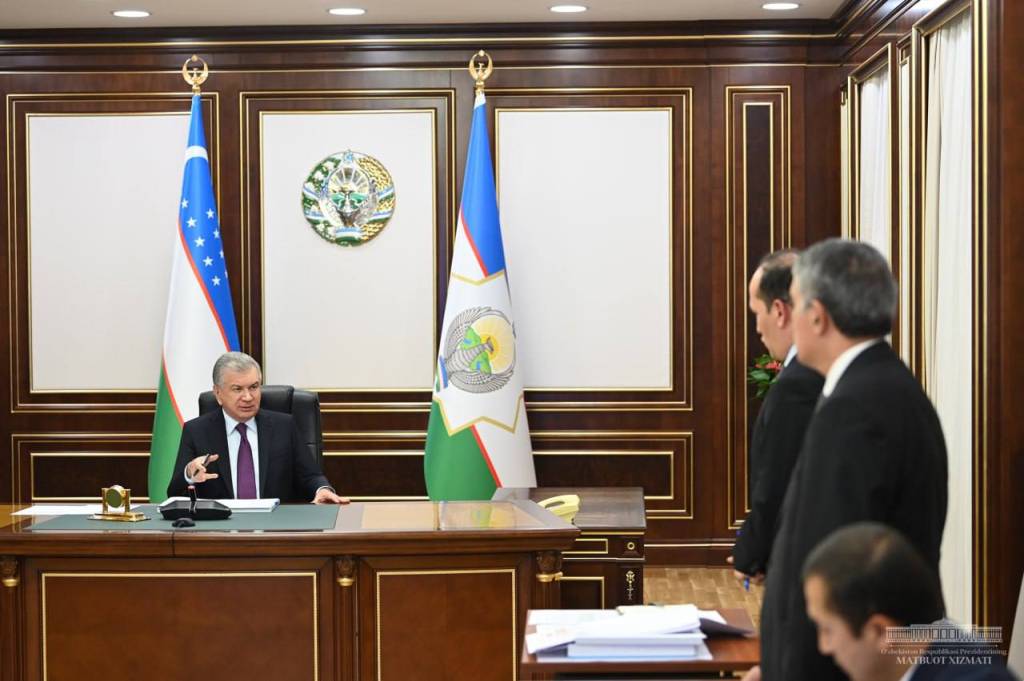
Despite these efforts, there are still issues that impede the further development of this work. For example, the authority of district irrigation departments is limited to inter-farm canals. In addition, water supply services are not adequately funded and the bank loans allocated for introducing water-saving technologies are not attractive to farmers.
In response to this, the Head of State proposed measures to improve the lower level of water resources management and increase efficiency. To this end, it was suggested that state institutions “Suv yetkazib berish khizmatlari” (Water supply services) be set up based on regional irrigation departments and specialized services. These institutions will be provided with excavators and other equipment to reduce the cost of servicing irrigation networks by half.
Moreover, it was proposed to conduct an inventory of all irrigation networks, assign them to their owners and create a single identification number. Starting this year, the payment for one cubic meter of water supplied to the field is set at 100 UZS. This is intended to change the perception that water is free.

To further motivate the implementation of water-saving technologies, a preferential credit line was proposed. Loans will be issued at 14 percent for 5 years with a two-year grace period. For projects in the Republic of Karakalpakstan and Khorezm region, the rate will be 10 percent. Farmers will not be required to pledge property when receiving such loans.
Additionally, a subsidy of 8 million UZS is provided for every hectare on which water-saving systems are installed. Until now, 50 percent of this amount was paid in the year the technology was installed, and the rest was paid the following year. This condition is also planned to be changed by paying the subsidy in full in the same year the technology was installed.
The Head of state approved these proposals and instructed on properly establishing a system to cover every end user and expand the scope of water conservation work.
UzA